
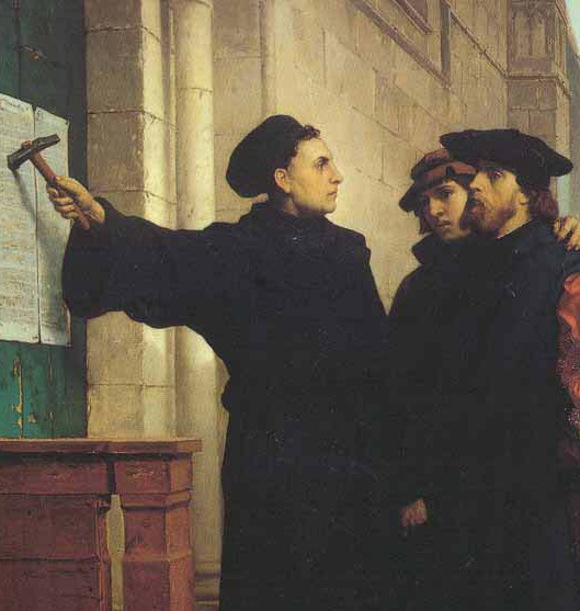
The Protestant Reformation is one of the most important events in history. It signified the beginning of a new era in history. Whether or not we want to acknowledge it, the Reformation’s effects were much broader than just being religious in nature. This is the event that set the stage for the democracy and freedom that we all enjoy in the Western World.
While the Protestant Reformation is often attributed solely to Martin Luther, there were other people who played a significant role. John Wycliffe and John Hus, for example, lived about a hundred years before Luther and laid the groundwork for Luther and the other Reformers.
During Luther’s lifetime, Huldriech Zwingli, John Calvin, and John Knox were also very influential in spreading the Reformation teaching throughout Europe. John Calvin is often regarded as the primary theologian of the Reformation. Calvin founded the Presbyterian Church and wrote “Institutes of the Christian Religion,” the treatise on Reformation theology. Calvin is still regarded as one of the Church’s great theologians.
There is no doubt, though, that Martin Luther was the primary reformer and, in many ways, had the most influence in bringing about significant change in Germany and in other parts of Europe. In 1517, Luther nailed his “Ninety-Five Theses” to the chapel door at the University of Wittenberg where he taught. These theses outlined his critique against the Roman Catholic Church’s sale of indulgences, which Luther believed was unscriptural. Luther also argued for justification by faith alone. This would be the beginning of a long battle between Luther and the Catholic Church. He would eventually be excommunicated.
Luther’s spiritual journey had started with his own spiritual disillusionment and is one of the most fascinating conversion stories in history. He had became a monk against his father’s wishes. Even as a monk, however, Luther felt separated from God. He felt that no matter what he did, God was not pleased with him. Luther fasted, prayed, went on pilgrimages, and made frequent confessions, but nothing brought him peace. He still felt far away from God and felt that God was always angry with him, similar to how he felt about his earthly father.
In 1515, Luther was asked to lecture on Paul’s letter to the Romans. As he was studying and preparing for his lectures, he came across Romans 1:17. This verse changed his life and the course of history. Luther came to the understanding that he could never earn God’s favor. Salvation was a gift given from God, solely given by grace, and had to be received by faith.
Luther and the other Reformers agreed on three primary Fundamentals of Christian Doctrine. These are considered the core planks of reformation theology.
1. The Sole Authority of Scripture. From the very beginning, after Luther’s conversion, he argued that the Scriptures should be the only authority for doctrine and practice in the Church. This was at the very heart of the sale of indulgences. The Roman Catholic Church holds that tradition and the Scriptures have equal authority. God’s Word always trumps the traditions of men.
2. By Faith Alone. Luther experienced this first-hand. It was not all the religious practices or good deeds that he had done that brought about his salvation. It was only when he exercised his faith in the completed work of Christ and received it by faith that Luther was justified before God. This was exactly what the Apostle Paul taught in Ephesians 2:8-9.
3. The Priesthood of All Believers. This Reformation fundamental taught that every Christian has access to God through Jesus. They do not need a priest to mediate for them. This teaching hit at the heart of the Roman Catholic doctrines of confession, the mediation of the saints, and, most importantly, the authority of the Pope.
The Reformation had wide-reaching consequences beyond the walls of the Reformed Churches that sprang up throughout Europe. Even today, almost five hundred years later, these three fundamentals are still held to by most segments of Protestantism. Most Protestant Christians view the Reformation as a return to Biblical Christianity.
My wife, Annie, and I are developing leaders and helping to fulfill the Great Commission in the US, Africa, India, Nepal and South America. Would you consider supporting us with a one-time gift or even becoming a part of our support team? Just click here to get involved. Thanks so much!
